

Automatic Car Wash Machine in India: The Complete Guide to Commercial Car Wash Machines and Equipment Manufacturers in Coimbatore
An automatic car wash machine in India is a system that washes a vehicle’s body, underbody, or both using programmed pressure jets, sensors, and foam applicators instead of manual labor, cutting a wash that once took fifteen to twenty minutes down to a few. For anyone running a car wash, detailing center, or service station, that gap between manual and automated washing is often the difference between a business that scales smoothly and one that stays stuck fighting the same water, labor, and bottleneck problems every single day.
This guide walks through what these machines actually do, what a genuine commercial car wash machine setup looks like, how hydraulic washing lifts fit into the picture, and why so much of this equipment traces back to manufacturers in Coimbatore, Tamil Nadu, one of India’s established hubs for automotive service equipment.
Anyone researching this space quickly runs into a wide spread of options, from basic semi-automatic units to fully robotic wash lines, each with different water usage, cycle times, and footprint requirements. The goal of this guide is to make that comparison concrete rather than theoretical, using the actual specifications, certifications, and manufacturing details behind the equipment rather than generic marketing language repeated across most car wash content online.
Why Manual Car Wash Operations Struggle to Scale
Running a wash bay with a crew of workers and a hose looks simple on paper, but the math rarely holds up once volume increases. Water usage swings depending on who is on shift and how careful they are being that day. Wash quality varies with fatigue, weather, and simple inconsistency between workers. And the vehicles themselves sit in the bay far longer than they need to, which quietly turns into a bottleneck for a business that would otherwise be profitable.
Underbody cleaning tends to be the part that suffers most. Without a hydraulic washing lift, workers have to crouch or lie under each vehicle to reach the chassis, which slows the entire bay and often gets shortcut when things get busy. This is exactly the operational gap that an automatic car wash machine in India is built to close, replacing an unpredictable manual process with a repeatable one.
There’s a labor dimension to this too that’s easy to underestimate. Staffing a wash bay with enough workers to keep pace with demand is an ongoing recruitment and management cost, not a one-time expense. Turnover in manual wash roles tends to be high, which means training time gets repeated constantly, and every new hire reintroduces the same inconsistency in wash quality that automation is meant to remove in the first place. None of this shows up as clearly on a spreadsheet as the cost of the machine itself, but it compounds every month the business keeps relying on manual labor at volume.
How Much Water Does an Automatic Car Wash Machine Save?
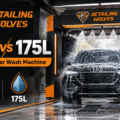
Water consumption is one of the clearest, most measurable differences between manual and automated washing. Touchless automatic systems from manufacturers like Schumak Equipment use approximately 125 liters of water per wash, compared to roughly 175 liters typically used by other automatic systems on the market. At commercial volumes, that difference compounds quickly across dozens of vehicles a day.
Speed follows the same pattern. A properly engineered touchless system completes a full wash cycle in roughly three to three and a half minutes, covering the vehicle body, the under-chassis, or both depending on the configuration. That speed only holds up, though, if under-chassis access isn’t the bottleneck, which is precisely the problem a hydraulic washing lift is designed to solve by letting the underbody be reached quickly instead of slowing the whole cycle down.
Commercial Car Wash Machine Options: Touchless, Robotic, Under-Chassis, and Semi-Automatic
Not every site needs the same configuration, and a genuine commercial car wash machine manufacturer will typically offer more than one format depending on throughput, budget, and site layout.
| System Type | Best Suited For | Key Characteristic |
| Touchless car wash | Sites prioritizing paint safety | High-pressure spray and foam application without brushes touching the vehicle |
| Robotic car body washing | Higher-throughput sites | Built for speed and consistency at volume |
| Under-chassis washing | Operations targeting road grime and corrosion | Cleans the part of the vehicle manual washing almost always shortcuts |
| Semi-automatic and brushless | Smaller sites or tighter budgets | A middle ground between full automation and manual control |
Each configuration is aimed at the same three cost centers every commercial wash operator deals with: water, time, and labor, while still improving the one thing customers actually judge the business on, how clean the car looks when it drives out.
Why the Hydraulic Washing Lift Is Part of the Same Story
Washing a vehicle properly, especially underneath, is difficult without lifting it to a comfortable working height, and doing that safely and repeatedly is its own engineering problem. This is where a hydraulic washing lift comes in, and it’s worth understanding as part of the same equipment category rather than an unrelated add-on.
Manufacturers in this space, including Schumak, produce hydraulic washing lifts across a wide range of capacities, from 1 ton units suited to passenger cars up through 2 ton, 4 ton, 8 ton, 16 ton, and 25 ton configurations designed for light commercial vehicles and heavier loads. Within that range, formats vary too, including Standard, Spider Arms, TRP In-Built, TRP Pro, and Twin Post designs, each suited to different bay layouts and workloads. Rather than workers crouching under a vehicle to clean the chassis, a hydraulic lift raises it to a safe, comfortable height, cutting undercarriage wash time and improving the thoroughness of the job at the same time.
The reason so many configurations exist rather than one universal design comes down to how differently wash bays are actually built. A single-post standard lift suits a site with straightforward passenger car traffic and limited floor space, while a twin post design is built for higher tonnage and heavier vehicle mixes. Spider arm and TRP-style lifts change how the vehicle is supported and accessed, which matters when a bay is also handling detailing work underneath rather than a quick rinse. Matching lift type to actual vehicle mix and bay layout, rather than defaulting to whatever is cheapest, is one of the more consequential decisions in setting up a wash operation, since a poorly matched lift ends up creating the same bottleneck it was meant to remove. You can see the full specification range for Schumak’s automatic car wash machines in India alongside the lift options built to work with them.
Car Wash Equipment Manufacturers in Coimbatore: What Sets Schumak Apart
Search for car wash equipment manufacturers in Coimbatore and it becomes clear fairly quickly that the city is a genuine manufacturing hub for this category, not just a place where a few resellers happen to operate. Schumak Equipment (India) Pvt Ltd has been building automotive service equipment since 1999, operating from an ISO 9001:2015, CE, and TÜV SÜD certified facility at Kanuvai Industrial Estate in Coimbatore, Tamil Nadu.
That distinction between a manufacturer and a trading company matters more than it might seem at first. A commercial car wash machine bought from a company that engineers and builds its own equipment locally is a very different proposition from one bought through a reseller who disappears the moment a spare part is needed. Over 25 years, Schumak has grown into a business with a dealer network of 21 or more locations across India, exports to 18 or more countries, and more than 5,500 customers served. Its equipment has been approved by original equipment manufacturers including Maruti Suzuki, Toyota, Mahindra, Hyundai, and Tata, along with the Indian Army, the kind of validation that comes from repeated real-world use rather than a product that only looks good in a brochure.
Being manufactured and supported from Coimbatore also has a practical benefit that’s easy to overlook: faster response times for installation, servicing, and spare parts across South India, compared to sourcing equipment from a distant manufacturer or an importer with no local service infrastructure. That matters especially for a hydraulic washing lift, since hydraulic systems need periodic maintenance to stay safe, something a distant supplier simply cannot turn around quickly.
The certifications themselves are worth understanding rather than skimming past. ISO 9001:2015 is a quality management standard that covers how consistently a manufacturer designs, builds, and tests its equipment, not just whether a single unit passed inspection once. CE marking indicates the equipment meets recognized safety and performance requirements accepted across European markets, which is part of why Schumak’s equipment has been exportable to markets like the UK. TÜV SÜD certification adds an additional layer of independent safety testing, which matters directly for load-bearing equipment like a hydraulic washing lift, where a manufacturing shortcut could translate into a real safety issue rather than just a quality complaint.
What to Check Before Choosing a Car Wash Equipment Manufacturer
Given how many car wash equipment manufacturers in Coimbatore and elsewhere in India now advertise online, a short checklist helps separate a genuine manufacturer from a reseller repackaging someone else’s product.
- Ask whether the company actually manufactures the equipment in-house or imports and rebrands it, since spare parts and service quality depend heavily on which one is true.
- Check for recognized certifications such as ISO 9001, CE, or TÜV SÜD rather than taking quality claims at face value.
- Ask about the dealer or service network in your region, since installation and future maintenance both depend on how quickly a technician can reach your site.
- Look at whether the manufacturer’s equipment has been adopted by OEM workshops or recognized fleet operators, which is a stronger signal than customer testimonials alone.
- Confirm whether the manufacturer produces a full range, including hydraulic lifts, air compressors, and interior cleaning equipment, or only the wash machine itself, since a narrower product range often means less experience solving problems across a full wash bay.
Beyond Washing: The Wider Equipment Range Worth Knowing About
Car wash equipment manufacturers in Coimbatore serving this space typically extend well beyond the wash machine itself. Schumak’s product range, for example, includes touchless car wash systems in multiple versions, dedicated under-chassis wash units, automatic bike wash systems in both cabin and open-type formats, two-stage and mini air compressors, vacuum cleaners and spray extraction units for interior cleaning, lube and grease pumps, single and triple plunger vehicle washers, and body shop equipment such as two-post and four-post lifts, dent pullers, and paint booths.
For a business planning a full car wash or detailing setup rather than a single machine, this matters because it means equipment across the whole workflow, from the wash bay to interior cleaning to general garage servicing, can come from one manufacturer with one point of accountability, rather than being pieced together from multiple unrelated suppliers.
Is This Equipment Right for a New or Franchise Car Wash Setup?
Whether an automatic car wash machine in India makes sense for a new business or franchise location usually comes down to expected volume rather than the size of the investment alone. A site processing a handful of vehicles a day may get by comfortably with a semi-automatic configuration, while a high-traffic location benefits far more from a full touchless or robotic system paired with a hydraulic washing lift for underbody work.
It’s also worth noting that this isn’t equipment reserved only for large operators. The same commercial car wash machine and hydraulic lift ranges supplied to established brands and OEM-approved workshops are equally available to independent garages, new car wash businesses, and franchise investors setting up their first facility, which is a meaningful difference from a manufacturer that only sells equipment it doesn’t actually rely on itself.
For someone opening their first wash location, the temptation is often to under-invest in equipment early and upgrade later once volume justifies it. In practice, this usually means retrofitting a bay that was never designed for automation, which costs more in the long run than planning the layout around a hydraulic lift and wash system from the start. Franchise operators in particular benefit from standardizing on one equipment setup across locations, since it simplifies training, spare parts stocking, and service scheduling compared to each location sourcing its own machines independently.
Frequently Asked Questions
What does an automatic car wash machine in India typically cost? Pricing varies by system type, whether touchless, robotic, or semi-automatic, and by the throughput capacity a site needs. Getting a quotation matched to expected daily volume is the most reliable way to compare options.
How much water does an automatic car wash machine actually save? Touchless systems from manufacturers like Schumak use approximately 125 liters per wash, compared to around 175 liters used by many other automatic systems on the market, a meaningful reduction once scaled across commercial daily volumes.
Is a hydraulic washing lift necessary for a car wash business? It isn’t strictly mandatory, but it significantly speeds up and improves under-chassis washing, which is otherwise slow and inconsistent to do manually. For any operation handling meaningful daily volume, a lift is one of the more valuable equipment investments available.
Is this equipment suitable for franchise or new car wash setups? Yes. The same equipment ranges used in established, OEM-approved workshops are also supplied independently to garages and wash operators setting up their own facilities for the first time.
Who manufactures this kind of equipment, and where? Companies such as Schumak Equipment (India) Pvt Ltd, based in Coimbatore, Tamil Nadu, manufacture this equipment in-house from ISO 9001:2015, CE, and TÜV SÜD certified facilities, rather than importing or reselling machines built elsewhere.
Choosing the Right Setup
An automatic car wash machine in India isn’t a single product so much as a category of decisions: touchless versus robotic versus semi-automatic, what tonnage of hydraulic washing lift a site needs, and whether the manufacturer behind the equipment can actually service it locally once it’s installed. Working through those decisions with a manufacturer that builds, certifies, and supports its own equipment from Coimbatore removes a large part of the guesswork involved in setting up or upgrading a commercial wash operation.
None of these decisions need to be made in isolation, either. Water usage, cycle time, lift tonnage, and manufacturer service all interact with each other, and getting one wrong, such as choosing a lift that doesn’t match the site’s vehicle mix, can undermine the benefit of an otherwise well-chosen wash system. Treating the equipment as one connected setup, rather than a single machine purchase, is what tends to separate wash operations that run smoothly from ones that keep hitting the same bottlenecks manual washing was supposed to leave behind.
To see the full specification range for touchless systems, hydraulic washing lifts, and the rest of the commercial car wash machine lineup, visit Schumak’s automatic car wash machine page for details and a quotation matched to your site’s volume.



1 Comment
Automatic Car Wash Machine in India: Water Savings
[…] Automatic Car Wash Machine in India engineered specifically around water efficiency closes this gap through precision rather than […]